
The Toronto Maple Leafs came into this offseason with many things on their agenda, but the two items of highest priority were re-signing Auston Matthews and William Nylander. There was a lot of talk in hockey media about how difficult this may be for the Leafs, especially after the disappointing end to the season end and subsequent front-office dismantling. Uncertainty surrounded the team, with Kyle Dubas leaving and taking Jason Spezza with him. They didn’t even have a general manager until the middle of June! Many speculated that Matthews and Nylander would/could leverage their no movement and no trade clauses that kicked in on July 1st. We were told by pretty much anyone who wasn’t a Leafs fan that Matthews would leave for Arizona (lol), New York, or LA the first chance he got.
However, like most things regarding the Leafs, it has become clear that these rumours were blown out of proportion, and hockey fans continuously make fools of themselves when talking about Toronto. Just a few weeks ago, the Leafs re-signed their former MVP to a record-breaking contract that ensured he would stay with Toronto until his early thirties. Now, all eyes are on Nylander, whose contract expires after this upcoming season.
Regarding Matthews, the discourse in Leafland was more about whether they would re-sign him, not whether they should. I’m not going to act like there wasn’t a real fear amongst Leaf fans that Matthews would go somewhere warmer, closer to home and less media-frenzied. When he re-signed, for the most part, the cap hit was irrelevant. I was just relieved he wasn’t leaving. The situation isn’t the same for Nylander, who has had his detractors since Toronto drafted him in 2014. Many Leaf fans would have no issue letting the dynamic Swede walk and spend that cap space elsewhere.
The idea that the Leafs are too reliant on four forwards and should balance out their cap space more throughout their lineup is popular. However, the Leafs front office (hopefully) understands that losing Nylander would be a catastrophic blow to the team’s ceiling over the next five years. Let’s discuss how important William Nylander is to the Toronto Maple Leafs and why they must re-sign him.
William Nylander has improved season after season since he signed his initial six-year contract in 2018 with the Leafs. Last year was his best season yet, as the Swede finished with 40 goals and 47 assists in 82 games, both career highs. Nylander reached a level we hadn’t seen from him before last year, and his consistency throughout the year was impressive. It’s even more impressive considering he played without Auston Matthews or Mitch Marner for almost 50% of his five-on-five ice time.
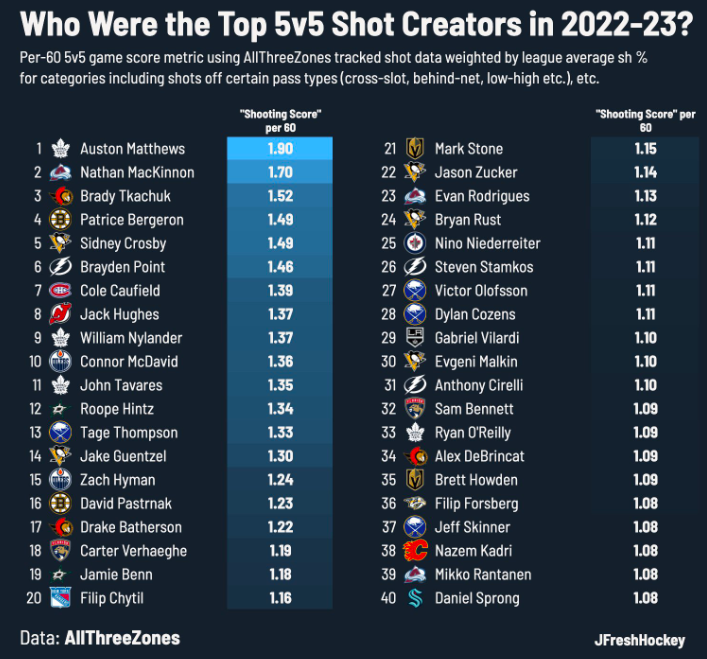
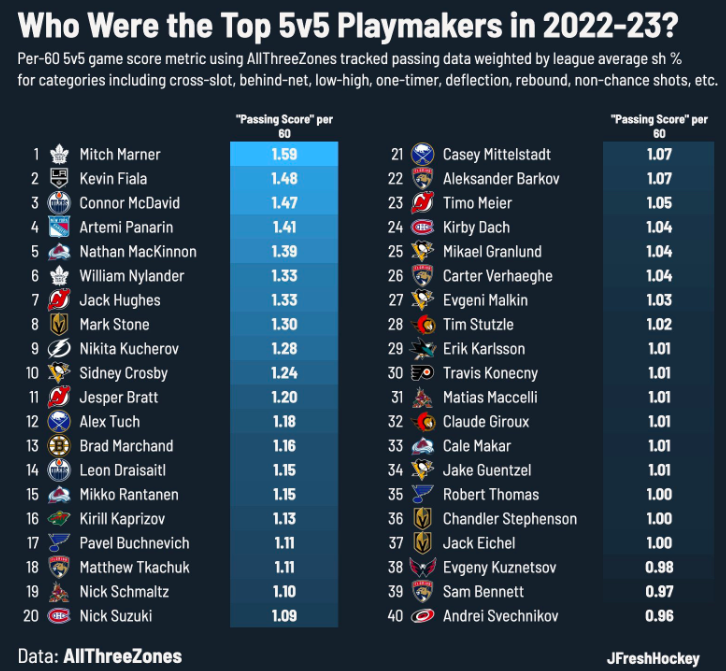
Digging deeper, we can look at these lists from JFreshHockey and AllThreeZones data showing Nylander’s involvement last season (9th and 6th). His ability to be a dual threat is unmatched on this Leaf roster, and in fact, it’s matched only by a few elite players in the entire NHL. The only players in the top 10 of both of these lists are Connor McDavid, Sidney Crosby, Nathan MacKinnon, Jack Hughes and William Nylander. Decent company.
The Swede has also shown that when other superstars on the Leaf roster aren’t performing, he’ll be the one to pick up the slack. He was far and away Toronto’s best forward in the second round of the playoffs last season while Matthews and Marner floundered in obscurity. And similar could be said about his playoff performance against Montreal in 2021. He picked up the slack while Matthews and Marner were shut down by Phil Danault and Co, leading the team in goals and points. The Leafs abundance of star forwards makes it so that if not everyone is at their best, their offence is still dangerous because you never know who might take over a game on any given night. Losing Nylander minimizes this majorly.
I could bore you to death with metrics showing how good Nylander is because, trust me, there are a lot. But the fact is that the Leafs are a demonstrably better team when he is on the ice, and he doesn’t need to rely on Auston Matthews to produce either. At five-on-five last year, Toronto’s goals per 60 minutes with Nylander were 3.41. Without him, it was 2.57. Their expected goals per 60 with Willy on the ice was 3.51, and without him, 2.67.
Losing Nylander would also be crushing because his unique traits aren’t easily replaced. He is one of the best zone exit/zone entry players in the league, and the Leafs aren’t flushed with good puck transporters. In addition, with the offensive signings Toronto made in the offseason and the inclusion of Matthew Knies on the roster for an entire season, Nylander will have more skilled players to play with. No disrespect to Alex Kerfoot, but Nylander could have had ten to fifteen more assists if he had a decent finisher on his opposite wing.
Nylander certainly doesn’t always look like he is giving his full effort every single shift, but we should be past the point of turning those bad moments into a generalization of his work ethic as a whole. By all accounts, at this stage in his career, WIlly has a deep burning desire to get better, and his nonchalant playing style shouldn’t make people think otherwise. He has made it clear he wants to be in Toronto forever. Why aren’t we, as a collective fanbase, falling all over this guy?
In saying all this, Nylander isn’t signed to a long-term deal yet because he and the Leafs are apart regarding a valuation. Gauging a value for a player like #88 is challenging, especially when he plays on a team like Toronto with Tavares, Marner and Matthews already making more than him. However, looking at two recent big-money forward signings by other teams in the Eastern Conference can give us a pretty good idea of what Nylander should be getting. Timo Meier re-signed with New Jersey in June for 8 years with a yearly cap hit of $8.8 million. Sebastian Aho re-signed with Carolina in July for 8 years and an annual cap hit of $9.75 million. Both players are 26 (Meier turns 27 next month), and Nylander is 27. Nylander’s career high in goals and points is higher than both Meier’s and Aho’s, and he’s probably a more dominant offensive player than both.
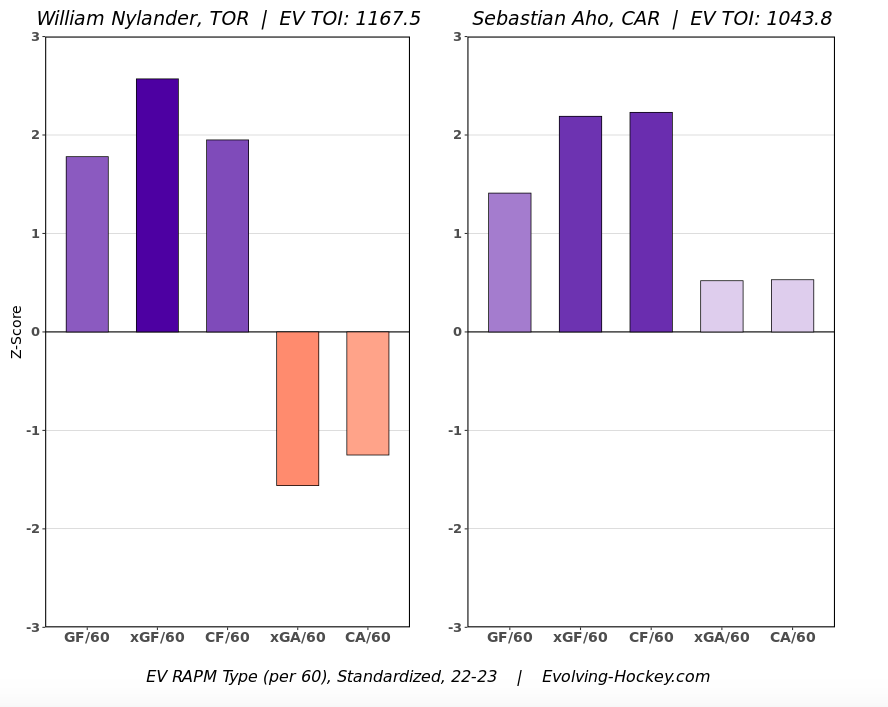
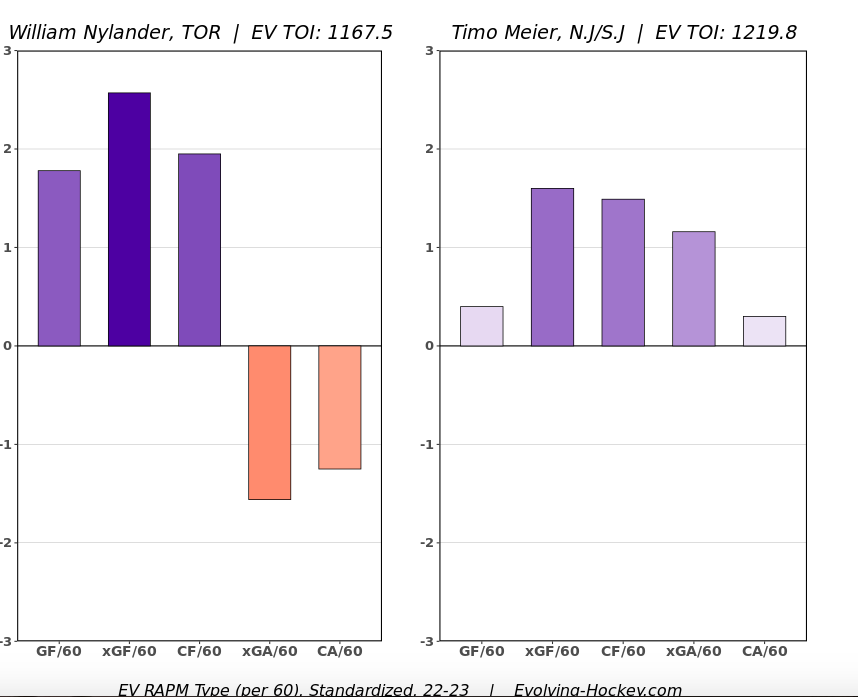
These charts help show Aho and Meier’s overall game is a bit more refined and where the Swede lacks. Meier and Aho are good comparisons because Nylander fits directly in the middle of their two contracts. Nylander is a better player than Timo Meier and worth more. They have similar career stats and score at a similar clip, but Nylander’s capacity to carry the puck and create for his teammates is a level above Meier’s. On the other hand, Aho plays a more valuable position than Nylander, has more goals and points in his career in a similar amount of games, and is a more complete player. Offensively, Aho isn’t as dynamic as the Leafs’ forward, but his other attributes make up for that.
Now that we’ve established Nylander is probably worth something between Meier and Aho, I think it’s important to note that the two ladder players signed eight-year deals. This means that the team is buying up more years of the player’s prime, taking away the chance at another contract and theoretically has to pay more to get the entire contract length. The Leafs seem to be operating on about a five-year window right now based on the moves they’ve made and the length of Auston Matthews’s contract, which means they can save a small amount of money in the short term. If Nylander were to sign for five years, using Aho and Meier as comps, I would have no problem giving him $9.5 million annually. The Swede will be just 33 by the time his contract is up, has not struggled with injuries, and seemingly has yet to reach his full potential. I should also mention that the salary cap is set to go up to roughly $87 million ($3.5 million increase) if everything goes to plan after this season, giving the Leafs more room to work with.
The reality is that what you lose from letting William Nylander walk is a much bigger hole to fill than the $500K a year you might lose out on by giving the Swede $9.5 million instead of $9 million. The Leafs already went through this with Nylander in 2018, and it’s clear that being stubborn over a couple hundred thousand dollars wasn’t smart in the long run. If this team is going to win by the time Matthews’ contract expires, then it is going to be with Nylander. I’ll reiterate that finding 40-goal, 85-point scorers under 30 in the NHL is not easy. You either have to pick early in the drafts (which the Leafs haven’t done since 2016) or overpay in a trade or free agency. I’d much rather overpay slightly in the short term for someone we know who wants to be here, has developed chemistry with his teammates over seven years, and is at the same stage in his career as our other stars.
Fictional cap space is awesome, but it all depends on what you will do with that cap space. The Leafs want to extend their competitive window as long as possible, and what the Matthews contract shows is that the new front office will still be working on the core four. This does not mean I’d advise letting Nylander and his team run you ragged and demand whatever he wants, but the Leafs need to remember what the end goal is here and how important Nylander is to helping them achieve that goal. He significantly increases your chances of winning a Stanley Cup; don’t let him walk away without doing everything you can to keep him here.
 The Morning Skate