
Toronto’s 4-3 comeback victory against their playoff rival Tampa Bay Lightning was a big two points for a team staring down a third consecutive loss with ten minutes to go in the third period on Saturday night. But the Leafs’ win was meaningful for more reasons than just stopping a losing streak and beating a division rival. Saturday night was the first time this season that Matthew Knies showed just how good he is, which is crucial for Toronto. At just 21, Knies is the youngest player on the Leaf roster. However, by the end of the season, he could also be one of Toronto’s most important. Let’s dive into why.
When you have four forwards taking up close to 50% of your team’s total cap hit, it is understandable that, as a team, the rest of your cap space probably won’t be used to acquire more top-end offensive talent. The Leafs have had to balance this out throughout the years of John Tavares, Mitch Marner, Auston Matthews and William Nylander being on the team together. Kyle Dubas often tried to find diamonds in the rough in the bargain bin to fill out the other eight spots on his forward lines, and more often than not, these players looked a lot more like coal than diamonds.
The expectations were that Toronto’s big four forwards would cover so much of the production that it didn’t really matter who you put next to them. And for the most part, that has been the case until it hasn’t. Make no mistake, Tavares, Marner, Matthews, and Nylander have (mostly) been phenomenal over their careers as Maple Leafs. But this isn’t the NBA, and Toronto’s lack of scoring depth has gotten exposed in nearly every playoff loss they’ve had. That’s not to say the Leafs’ big four doesn’t need to be better and more consistent in the playoffs. They do. But they also need help.
Guys like Michael Bunting and Ryan O’Reilly were good at their jobs but rarely went above and beyond when not playing with one or even two of the aforementioned big four. For years, Toronto has needed (at least) one more forward who can not only finish opportunities when set up by Nylander or Marner but also create offence and drive a line by themselves.
Enter Matthew Knies, an all-action winger with a big body, sharp edges, and the type of skill that the Leafs’ lineup has been crying out for. When the Leafs drafted Knies back in 2021, there were whispers right away that the team may have gotten a first-round talent in the middle of the second round. Those whispers quickly became much louder after Knies went back to college and dominated, putting up back-to-back seasons with over a point per game.
Knies had the type of highlights at the Univeristy of Minnesota that you couldn’t help but get reactionary about as a Leaf fan.
He regularly embarrassed defensemen with his stick skills and scored the type of goals that reminded us of Auston Matthews. Still, the level of college hockey isn’t always the greatest, so I tried to keep my expectations muted when Toronto finally called up Knies.
Then I saw him doing stuff like this in his second career game, and I started pencilling him in for the Calder Trophy and 40 goals every year.
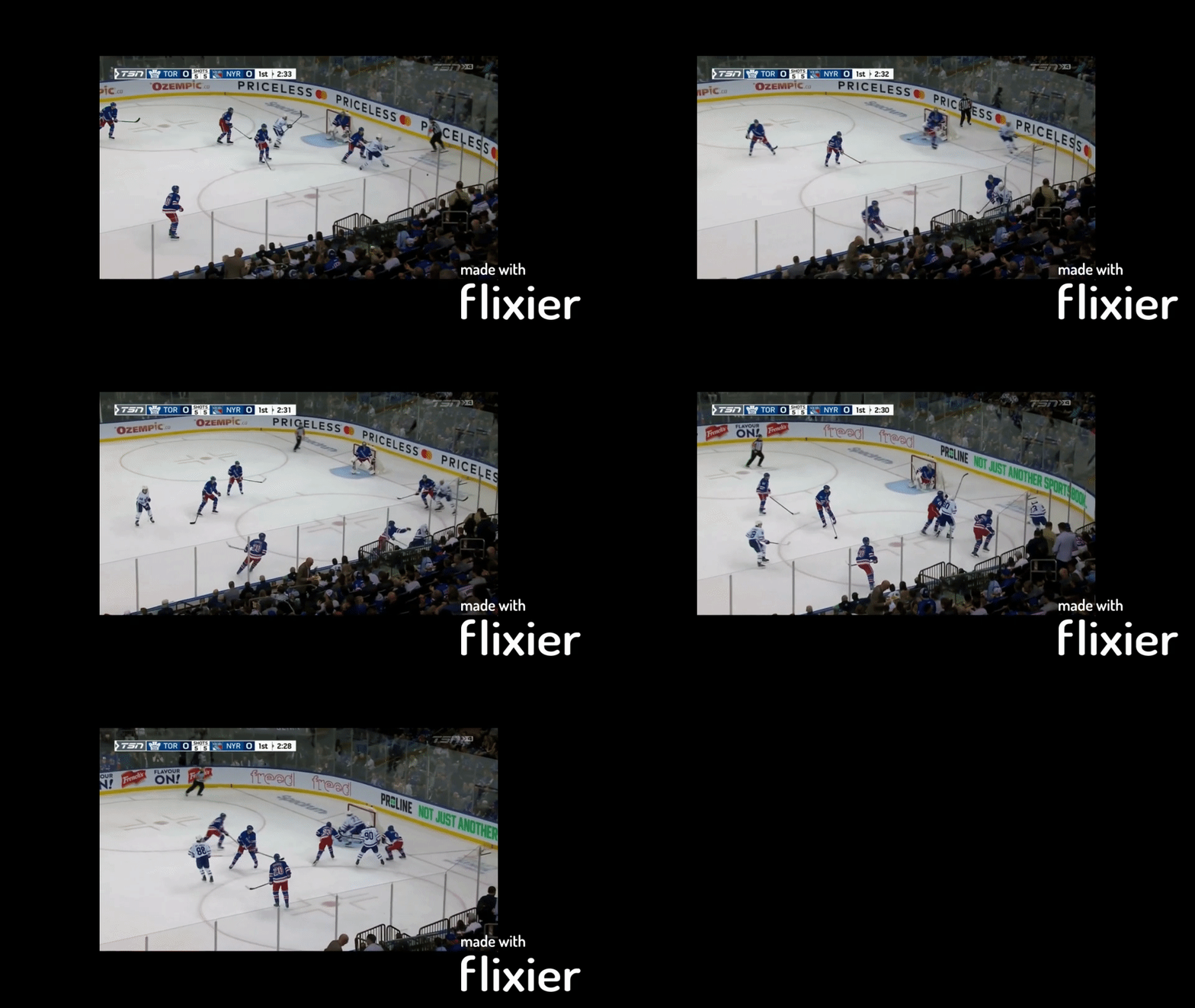
Knies showed immediately why all the hype around him was warranted. Despite playing just three regular-season games before the playoffs started, the 21-year-old was vital to the Leafs’ offence in the series against Tampa. His on-ice expected goals of 63% were the best amongst Leaf forwards in the playoffs, he was on the ice for all three overtime winners Toronto scored, and he consistently created chances no matter who was on his line. When Knies went down with an injury after getting mugged by Sam Bennett in game two against Florida, the Leafs offence looked much less dangerous for the rest of the series.
What makes Knies unique amongst Leaf wingers is his combination of physicality and elite puck skills. He has all the makings of a modern-day power forward. The former Golden Gopher is an excellent forechecker and is relentless on the puck in the offensive zone. Nylander and Marner are also underrated forecheckers, but they use their sticks and anticipation intelligently to trick defenders into giving them the puck. Knies, conversely, will just go straight at a defender and use his 6’2, 200-pound frame to take back the puck. Here’s an example from last year’s playoffs.

His body control/positioning is excellent, and he can use the boards to his advantage, thanks to his abilities with the puck on his stick. One of the hardest things to do in the NHL is to take the puck off the boards and get it into the middle of the ice with control; Knies has shown an uncanny ability to do this consistently just fifteen games into his NHL career. Here is an example…

Knies uses those sharp edges I mentioned earlier to create separation out of seemingly nowhere and then uses his body to attack the middle of the ice. One moment, he’s on the half-wall facing his own net, and almost instantly, he creates a high-danger scoring chance for himself.
These are the types of attributes that a player must have if he wants to be able to drive a line by himself, and Knies has them. Michael Bunting and Alex Kerfoot didn’t.
Knies is more than just a big body, though, and we saw that Saturday against Tampa. The Arizona native was highly touted coming out of college primarily because of the many different ways he can put the puck into the back of the net. We saw how good his shot was on his first goal against the Lightning; his release was lightning-quick, and the puck flew directly into the top corner. But it was Knies’ second goal that really stuck with me after the game.
The way he picked up the Max Domi pass with his skate and shovelled it past the goalie all in one motion (while falling) was incredibly impressive. That is ELITE skill on display. I tried to imagine a past Leaf winger doing that, like Alex Kerfoot, and couldn’t help but laugh.
Knies’s unique traits are crucial because the Leafs need to be able to beat teams in different ways. Toronto has struggled in the playoffs when plan A isn’t working or if a few Big Four members have off nights. Knies has the potential to be the first forward since Nazem Kadri to be on a similar level skill-wise as Matthews, Marner, Tavares and Nylander. That may sound like hyperbole or unfair expectations, but I am only projecting based on what Knies has shown throughout the start of his NHL career.
As Vegas showed last season in their march to the Stanley Cup, the hardest thing to stop is a team with waves of offence, not just moments. The Leafs have never had the bottom six to keep up those waves of offence. But they should be a team that piles the pressure on shift after shift. If Knies can become as good as I think he can and form a formidable third line with Max Domi, the Leafs will have three lines with elite offensive talent on each.
Sheldon Keefe has options with Knies, and I am sure he is excited to utilize those options. He must find creative ways to get the 21-year-old ice time because good things tend to happen when Knies is out there. The young winger sometimes tends to struggle in his own end, and he has to take better care of the puck in the neutral zone. But it’s important to remember he is just fifteen games into his career. Knies’s confidence will only grow if Keefe gives him the opportunities with Matthews Nylander and the chance to drive his own line. This player is built for the modern NHL and for playoff hockey, and his development over the season is essential if the Leafs want to go deep in May and June.
 The Morning Skate