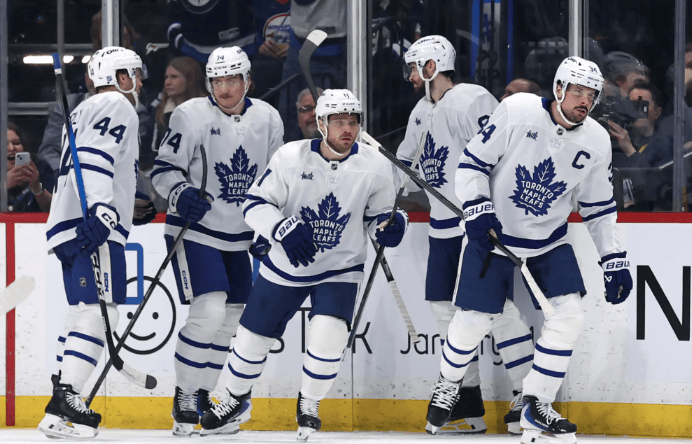
The enigma that is the 2025-26 Toronto Maple Leafs has continued to drive Leaf fans insane over the last couple of weeks. After a 0-5-1 stretch where they were vastly outplayed in nearly all of the games, the decision seemed obvious: it was time to sell. Toronto sat last in the Atlantic division, ten points out of the final wildcard spot. The team was even starting to make it clear that they were ready to call it quits on the season. But then, Western Canada happened.
The Leafs took full advantage of some freebies against Vancouver and Calgary, the two worst teams in the league, and managed to pull out two points against a struggling Oilers team on Tuesday, largely thanks to Anthony Stolarz. None of the three games was particularly pretty, but the wins might muddy the waters for the management group now that their team sits six points out of a playoff spot, not ten. The reality is that it shouldn’t change a thing.
Sure, Toronto feasibly could make the playoffs, but they’d have to go nuts over these next 25 games even to have a chance of doing so. This season has shown that they’re nowhere near competing for a Stanley Cup, and a retool is needed. The organization also has one of the league’s weakest prospect pools and a remarkable lack of draft capital. In the next two drafts, Toronto currently owns two picks inside the first three rounds, this year’s 3rd rounder, and next year’s 2nd rounder. Things are BLEAK.
Brad Treliving’s concerns about job security shouldn’t stop the franchise from doing what is best for the hockey team. The Leafs have plenty of players they can trade who would entice contending teams to offer high-market-value in return. With so many teams still fighting for playoff spots, it is a buyer’s market right now, and Toronto has to take advantage of it, given how bare its asset cupboard is. So, we’re going to go over each Leafs player, talk about their season and decide whether Toronto should keep, sell, or wait and see.
Auston Matthews: Keep.
Starting with the highest-paid player on the roster and the captain, Matthews has been incredible since the calendar turned to 2026. It doesn’t excuse his lacklustre start to the season, but clearly something changed physically or mentally around mid-December because he has looked like a completely different player since then.
He’s skating faster, his shot looks a lot closer to what it once was, and he’s finding the middle of the ice more often. He’s first in the league in five-on-five goals and second in high danger chances and expected goals at five-on-five since Jan 1st. He’s doing all of this playing with Bobby McMann and Max Domi on his wing. It’s mightily impressive.
Obviously, you’re keeping Auston Matthews. Elliotte Friedman has reported that Matthews still has complete faith in the Leafs and has no interest in leaving, so you keep him until that is no longer the case.
William Nylander: Keep.
Not too much to say about Nylander. He leads the team in points despite missing 17 games. He’s signed for seven more years. His injury or re-injury against the Golden Knights a few weeks ago probably cost the Leafs a chance at the playoffs, as the team fell apart in the seven games he missed. Nonetheless, Willy has been Willy this season and is well on his way to another point-per-game season.
Matthew Knies: Keep.
It has been an odd year for Matthew Knies. Statistically, he is producing at a career-high pace, but he’s seemingly been injured for most of the season. The team’s made it very clear that Knies is playing through an injury. He’s been a game-time decision for a few games this season, and it’s obvious to anyone watching that he hasn’t been as fast or physical this season. He’s shown flashes, and, again, he is still producing, but he hasn’t been consistently impactful. The Olympic break should be the perfect medicine for Knies, as he will only fully recover if given time to rest.
Zooming out, I do think there is an interesting conversation about what Knies’s ultimate potential is, because that affects how you go about building the rest of this team. If you think the former second-round pick can be a bona fide first-line player and consistently score 35+ goals and 80 points, not only do you have a steal of a contract at $7.75M, but it gives you room to be more aggressive on defence. If Knies ends up being a nice top-six winger who is more of a 20-goal, 60-point player, I think your mindset changes.
I’m personally a massive fan of Knies game and think that at his best, his combination of size, skill and speed makes him a unicorn. The fact is, he has 46 points in 54 games while playing through an injury for almost the entire season. In a perfect world, Knies gets completely healthy over the next few weeks and has a monster finish to the season.
Morgan Rielly: Wait and see.
The sun is setting on the Morgan Rielly era in Toronto. He has been an incredible Leaf and will go down as one of the most beloved players the city has seen this century. But this year has been the final straw. I say wait and see because I don’t think this is a trade you can make during the season. There are too many moving parts, and interested teams will not be able to fit his salary. This is a trade that you make in the summer.
No player in the entire NHL has been on for more goals against at five-on-five this season than Rielly, a damning stat and one that outlines how terrible he’s gotten in his own zone. He makes $7.5 for four more seasons after this one. That’s bad! Still, I don’t think he is a complete cap dump at this point. Maybe that’s wishful thinking, but he puts up 40 points a year and can skate. Some teams will convince themselves that he could work in their system playing 18-19 minutes a night, instead of 22-23.
I’d be willing to retain $1M or $1.5M if I’m the Leafs and dangle Rielly out for a third-rounder or something like that. The cap space is more important than anything, and it’s just time for this relationship to end. Wait until the summer, see what the market is, and make the deal.
Jake McCabe: Keep.
Up and down year for McCabe, who at times has been the Leafs’ best player, and more recently has struggled to the point where he’s cost the team a game or two. I do think that he’s been affected by coming back too quickly from the ankle injury he suffered at the start of January, and the Olympic break will be big for him as well.
His contract is great; he’s an absolute warrior, and he is a very capable third or fourth defenseman. Toronto’s defence is such a disaster that he or Oliver Ekman-Larsson are tasked with being their number one minute muncher. That is on the front office, and fixing it should be their number one priority this offseason.
John Tavares: Keep.
There’s a theme with the Leafs this season: they have plenty of guys who will benefit from the Olympic break. There is not a man in the world who will benefit more than John Tavares. My guy has looked GASSED for about six weeks now after starting the season like he was 24 again. However, the fact that he took such a massive paycut to stay with his hometown team even after he was stripped of the captaincy shields him from pretty much any criticism in my eyes.
He is a perfectly fine 2C on a team with good center depth. 20 goals and 47 points at a cap hit of $4.4M is an absolute steal, no matter which way you slice it, and I think he’ll finish the season strong.
Chris Tanev: Keep.
Amazing when he plays, but who would’ve thought giving a 34-year-old with a bad injury history a six-year contract would be a risk? He should not play another game this year, and if he does, the team should be investigated for malpractice. Shut him down, and turn all focus to making him fully healthy for 26/27.
Max Domi: Wait and see.
I am out on Max Domi. I thought the contract was silly when it was signed, and it looks even worse now. Domi has been on for 28 goals at five-on-five this season, and 45 against. Staggeringly incompetent in his own zone and always good for a few mindboggling turnovers a game. He also holds the lineup hostage, as Auston Matthews’ wing is seemingly the only spot he can play without being a complete black hole.
Again, not a guy that you’ll be able to trade during the season, but certainly someone you should be looking to dump in the summer. He does not deliver enough value for his $3.75M annual salary, and you already have better, younger, cheaper versions of him in Maccelli, Robertson, and Cowan. You’re not going to get anything more than a late draft pick back, but this would be a pure cap dump anyway. I’d even go as far as attaching a fifth or sixth rounder to him just so long as he’s off the roster.
It was a fun idea, but it hasn’t worked out; move on.
Oliver Ekman-Larsson: Sell.
We’ve finally made it to our first sale. OEL has surpassed all expectations as a Leaf, and in an ideal world, I’d love for him to remain in Toronto for the next two years. But this is an opportunity you cannot pass up if you’re the organization. Simply looking at counting stats gives you an idea of how much of an outlier season this has been for OEL. 34 points in 57 games has him on pace for the most points in his career since 2015-16! His selection to the Olympic team shows how well he’s played this year, but can he really replicate it as he begins the wrong side of his 30’s?
At $3.5M for the next two years, any contender would be falling over themselves to add a player like OEL, who plays with physicality, has won a cup, and can contribute offensively. He can play in the top four or on the bottom pair, and knows how to run a power play.
The fact that he has a term gives Toronto options. You can be picky. If you aren’t blown away with an offer, then of course, there is no reason to force a trade. I’d be looking at something similar to what the team gave up for Brandon Carlo last season. A first-round pick and one of the team’s top five prospects is the minimum offer I would consider for OEL. But if an offer like that is available, it may be a good time to cash in and start getting younger on the backend.
Brandon Carlo: Sell?
Speaking of Brandon Carlo. It has been a tough year for Carlo, and a lot of that has nothing to do with things outside of his control. He had a brutal injury, which kept him out for 26 games this season. Meanwhile, Fraser Minten is having an incredible year for Boston, and the Bruins are probably going to get a top-15 draft pick from Toronto. The fact that the Leafs overpaid for Carlo is not his fault. It was a complete panic move by Treliving, and he got fleeced, but that must be set aside when analyzing what Carlo brings to the table.
However, he hasn’t brought a lot to the table this season. His 47% expected goals share at five on five is better than only Simon Benoit and Phil Myers on the Leafs, and it has looked like he’s lost some foot speed after his injury. You may think his poor on-ice stats are due to being partnered with Morgan Rielly, but it’s actually the opposite. With Rielly, Carlo hovers around a 50% xGF share and without him, it drops to 43%.
I don’t think Carlo is as bad as he’s shown this year. Even recently, you can tell he’s picked his game up a little bit and has been sturdier defensively. But his puck-moving and skating weaknesses are magnified on a Leafs team that is already so deficient in those two areas. Again, I think you should shop Carlo around and see what the market is. He has term, and teams will be interested in his size. You cannot fall into the trap of the sunk cost fallacy. Carlo is an asset, and if there’s value to be had in trading him, you do so. If not, then you give him a chance to bounceback next year.
Matias Maccelli: Wait and see.
So you’re telling me it probably wasn’t a great idea to scratch one of the Leafs’ seven best forwards for ten straight games while the team was playing like shit? Who would’ve thought? Ever since he went through that stretch of sitting in the press box, Maccelli has shown that the player who put up 57 points two years ago is still in there. He has 15 points in 24 games since he returned, and has given the Leafs another player who can create offence with his ability to keep the puck and find teammates.
Maccelli is a restricted free agent after this season, and I would be happy to bring him back on a one- or two-year bridge deal at or near his current salary. He hasn’t shown enough to warrant a long-term deal, but he’s certainly earned another chance to prove that he can be a productive middle-nine forward. If he expects some sort of sizeable raise, then you explore trading him and try to recoup the third-round pick you gave up for him.
Dakota Joshua: Keep.
Not a lot of options here for Joshua as he’s been out for nearly two months with a lacerated kidney. It’s unclear when he’ll play another game this season. He started to play quite well in the weeks leading up to his injury. Hopefully, that will continue next season.
Nic Roy: Keep.
One of many Buds who started the year off slowly, Roy has gotten better and better as the season has progressed. He has found some chemistry with Nick Robertson on the team’s third line and is showing that he can be more than just a defensive centre. A strong and willing puck transporter, Roy can skate well for a big guy, wins faceoffs at a high rate, and was an important part of a Stanley Cup champion.
His $3M cap hit is more than affordable, and I wonder if Roy’s offensive capabilities could be better utilized under a new coach. One of the Leafs’ biggest strengths is their depth at centre, and there’s no reason to weaken that when you have Roy locked up for next season.
Calle Jarnkrok: Sell.
Unrestricted free agent at the end of the season, I’m not sure who in their right mind would trade for Jarnkrok, but maybe someone’s willing to throw you a fifth-rounder? There’s no point spending time on Jarnkrok as he is probably the most irrelevant player on the roster.
Nick Robertson: Keep.
Despite seemingly requesting a trade for the past three seasons, Robertson is still a Leaf, and we’re happy to have him! The 25-year-old is finally getting consistent playing time in the team’s top nine and has been a bright spot for Toronto. His 12 goals and 14 assists in 54 games aren’t particularly outstanding, but at five on five, he ranks second on the Leafs in goals per 60 minutes and fifth behind Knies, Tavares, Matthews and Nylander in points/60.
I think there’s an argument to be made that Robertson isn’t getting enough playing time, as he rarely gets more than 13 minutes a game. His value has never been higher, but he’s still more valuable to the Leafs than what they would get in return if they traded him. The blue and white lack wingers who can score, and Robertson has proven that even in limited minutes, he can create chances and put the puck in the net. He is an RFA this summer, and it’ll be interesting to see how that negotiation plays out. At 25, I could see him being interested in a two or three-year deal to get some security, and if it brings the AAV down, Toronto should be happy to do that.
Scott Laughton: Sell.
Every Leaf fan loves Scott Laughton. I get it. He was a Leaf fan growing up, he reminds us of the early aughts Leafs, and he is clearly passionate about playing for the Buds. If he weren’t a UFA, of course, you keep him, but again, this comes down to getting value for expiring assets. Laughton’s cap hit of $1.5M makes him immensely attractive to any playoff team that is looking to improve its centre depth or add an impact penalty killer.
Treliving traded a first and a prospect for Laughton last year, and although you won’t be able to recoup those assets, perhaps you can entice a team to give you a first OR a top-five prospect. Even a second-rounder would be better than letting Laughton leave for nothing in the summer.
By no means should Toronto shut the door on re-signing Laughton, but they cannot be allowed to fall into the trap of giving a bottom-six player a long-term contract that could become an anchor in the future. See: Trent Frederic.
Steven Lorentz: Keep.
Lorentz is a quality fourth liner under contract for three more seasons at $1.35M. I’d like to see him find a few more goals here and there, but he does his job well and makes a formidable penalty-killing tandem with Laughton. He’ll be around next year.
Bobby McMann: Sell.
Now we come to Toronto’s best trade deadline asset. Bobby McMann has had a truly inspirational rise to becoming a soon-to-be 20-goal scorer in the NHL. Undrafted and playing in the ECHL until he was 25, McMann is now a pending unrestricted free agent who will be looking for life-changing money in the offseason. Considering his game-breaking speed and nasty wrister, I’m sure there’s a team out there that will give him exactly that. But it shouldn’t be the Leafs. McMann is turning 30 this summer and is a prime overpay candidate. It’s time to cash in.
His aforementioned skill set, paired with his minuscule cap hit, makes him a dream deadline addition for any contender. Reports are that he could fetch as much as a first-round pick, and more depending on how desperate teams get. Treliving must play his cards right here and take as much time as he needs to milk every drop of value out of McMann. Goals are the NHL’s hottest commodity, and McMann could have 25 by the time the deadline rolls around.
Simon Benoit: Sell?
I think you should see if there is a market out there for Benoit. A cheap, physical defenseman with size could be of interest to some playoff teams who want to get tougher. If someone is willing to dangle a second-rounder for Benoit, you have to accept that deal. Other than that, he is a fine sixth defenseman and you can definitely keep him around for next season.
Easton Cowan: Keep.
Great rookie year for Cowan so far, as he’s had his ups and downs and played in every spot in the lineup, including the first power play unit. We’ve seen the positives and negatives that come with his irrational confidence with the puck. He’s got incredible skill, and his decision-making will only improve as he progresses in age. It will be an important offseason for him, as he needs to build more muscle and endurance to play in what will now be an 84-game season.
Phillipe Myers: Send to Mars.
If there is a higher power out there, this man will never play another game for the Leafs again. Please put us out of our misery. Matt Benning cannot be worse than this man.
Troy Stecher: Keep.
What a year for Troy! The November waiver claim has become an integral part of the Leafs’ defensive core and routinely plays over 20 minutes a game. His ability to start breakouts with a pass or by carrying it himself is a rarity on a Toronto team that mostly has defenseman who love to bang the puck off the glass. Stecher’s been relatively productive, too. His 11 points in 38 games put him on pace for a career high in that category. His overall game has started to drop a bit in recent weeks, but he has still blown expectations out of the water for a team that sorely needed a player with his skill set.
The only worry is that Stecher is a UFA in the offseason and turns 32 in April. He may want to prioritize stability, as this will likely be his last chance to secure a decent-sized contract. Currently making league minimum, Stecher will probably look to at least double that salary, and maybe even into the low two’s annually. If Toronto can get Stecher on a two- or three-year deal for $2M a season, I think that’s a fair price, considering how well he has fit in with the team. Anything more than that may be a little rich for my taste, but I don’t think trading him at the deadline will bring you enough in return to make it worth it.
I understand that the front office still wants to compete for a playoff spot, and six points isn’t insurmountable. However, the team can still compete for the postseason even if they trade off pieces like McMann or Laughton. Yes, they are solid players, but losing them will not be the reason the Leafs miss out on the wildcard. Toronto will make the playoffs only if Nylander and Matthews catch fire, and the goalies return to last season’s form. If the Leafs do not sell, they will find themselves in purgatory this offseason, with little cap space and few trade options to improve the team. Standing still is not an option. Do the right thing, Brad.
 The Morning Skate